
David Freeman teaches English at the Lycée Français de New York, where he invites bilingual students to see literature as a living conversation about identity, creativity, and the world around them. He teaches middle and high school English, AP Language & Composition, and a two-year research seminar called Connaissance du Monde. His current work explores how technology is reshaping storytelling, selfhood, and the role of the Humanities in the age of AI.
Before joining the Lycée, David taught at Winchester College in England. He holds degrees in English and Education from Boston University and a master’s from Teachers College, Columbia University. A proud Rhode Island native, he’s also a lifelong Boston sports fan.
Teaching on a Fault Line
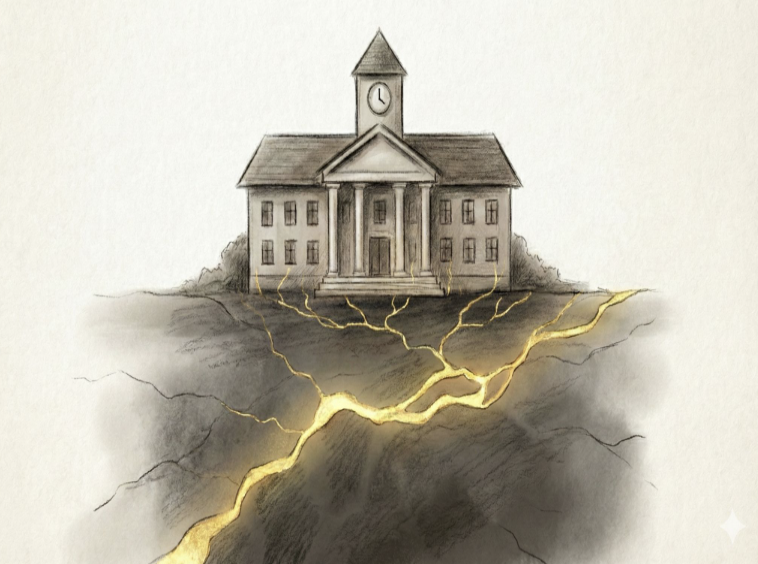
Teaching has always been built on a technological fault line. As teachers, we have built our home on ground that is always subject to disruption by the latest new tech. Sometimes we can ignore these new inventions (remember MOOCs?); other times they shake the foundation enough that we have to reckon with them.
For decades we've lived through technological tremors (calculators, computers, the internet, smartphones), but each time our home has stood strong. The structure has changed, to be sure. We've added extra supports and maybe some waterproofing. Built additions and ramps. Reshingled the roof. Still, the home we knew has withstood all comers.
But generative AI might just be "The Big One" that has long threatened to level our home. We can already see the cracks in our classrooms, and some of them are opening into fissures. Our tried and true pedagogy is falling through these cracks, and we are scrambling to patch them.
Our house probably won't come down tomorrow. But acting as if the ground beneath us isn't shifting would be irresponsible. So we need to prepare. This means reinforcing what should stay, but also rebuilding our practices to suit what's coming.
My work is about deciding what we keep and what we rebuild. I come at this as a classroom English teacher, testing ideas with my own students and sharing what works with colleagues. I want to preserve attention, judgment, and curiosity, along with the slow work of reading and thinking and the kind of friction that makes learning stick. I want to help teachers design learning that remains human as AI gets more capable. I want students to understand their own minds well enough that they don't hand them over. And I want to build practices that will hold up whether the shaking beneath our feet abates or increases.
If the home we love can't survive what's coming, then we need to build one that can.
Projects, Initiatives, Collaboration

TEDx Talk
Know Thy Selfie: Reclaiming Identity in the Algorithmic Age
A reflection on identity in the algorithmic age—complete with death metal and self-discovery.

LFNY Presentation
GPT as GPS: The State of AI in Schools in 2025
What it means to meet students where they are when “where they are” includes AI.

Search Engine
The Stupid Little Yogurt Question Podcast
A curious teacher, a skeptical class, and one surprisingly complicated yogurt question.

LFNY Presentation
What We “Ken” Do About AI in Teaching
A pop-culture lens on AI, education, and everything beyond our Ken.

TED-Ed
Why Shakespeare Loved Iambic Pentameter
Finding the heartbeat behind Shakespeare’s most enduring lines.
LFNY Presentation
CDM x AI: What Is Research Now?
How to evolve the global issues course in the age of machine intelligence.